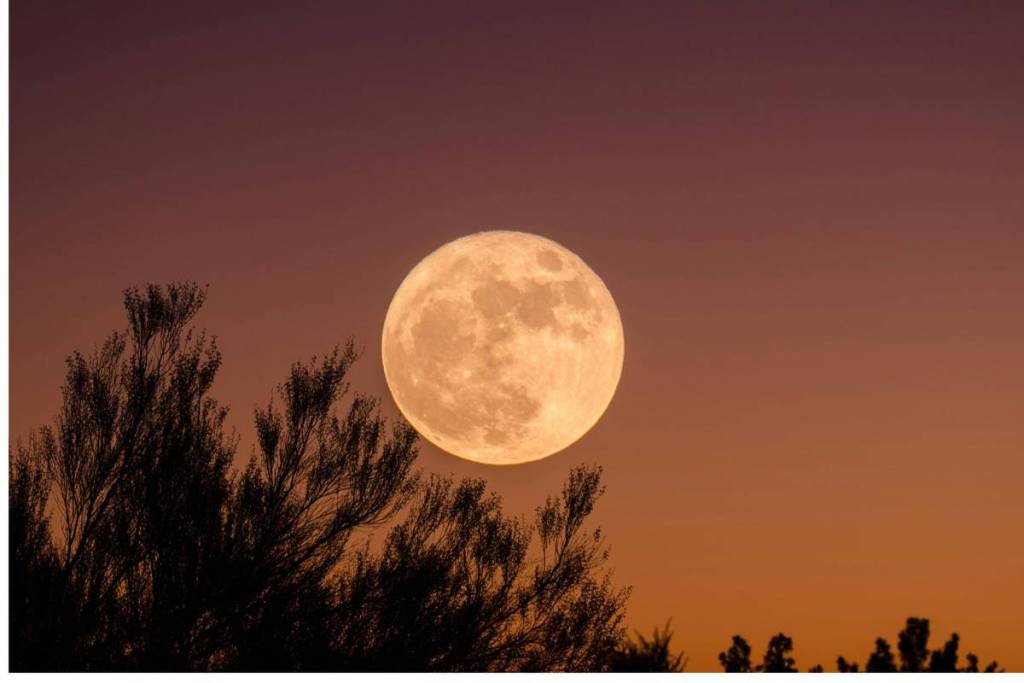

The Hunter’s Moon is a traditional name for the full Moon after the Harvest Moon. In 2026, September’s full Moon was the Harvest Moon, so October’s is the Hunter’s Moon.
The name reflects the season: after the harvest, communities prepared food for winter, and bright moonlight could help with hunting and other outdoor work.
It’s a nickname, not a different kind of Moon. The Hunter’s Moon won’t be physically larger or more colourful than other full Moons.
How to see the 2026 Hunter’s Moon
October’s full Moon will rise on the evening of Sunday 25 October 2026, offering a bright autumn sight alongside Saturn.
The Moon reaches peak illumination at 03:12 UTC on 25 October, that’s 04:12 BST in the UK, after the clocks go back overnight. It will look full to the naked eye on the evenings around the peak, too.
When and where to look at the Hunter Moon
Look towards the eastern horizon around sunset on 25 October to catch the Moon rising. It will travel across the sky through the night before setting in the west around dawn.
Choose a spot with a clear, unobstructed view east; buildings and trees can hide the Moon while it is low.
Saturn will be close by over the nights around 23–25 October. The Royal Observatory Greenwich says the pair will be together in the sky from around 9pm on 24 October until 3am on 25 October, appearing to move across the sky as the night goes on.
You can see both without optical equipment, although binoculars or a telescope can help bring out Saturn’s colour and, with a telescope, its rings.
The Moon may look larger than usual or take on a yellow, orange or reddish tint
As it rises, the Moon may look larger than usual or take on a yellow, orange or reddish tint. Its apparent size near the horizon is an optical effect known as the Moon illusion; its colour comes from moonlight passing through more of Earth’s atmosphere when the Moon is low. As it climbs higher, the colour should fade.
A full Moon is an easy naked-eye target, but its bright light can make subtle surface details harder to see than they are during a crescent or gibbous phase.
Still, try watching the Moon and Saturn together, taking a photograph, or looking for a halo if thin cloud is around.